Japanese beetle in Ticino: how to spot it, what to do and protect your garden
- Pests
- Lawn
- Garden
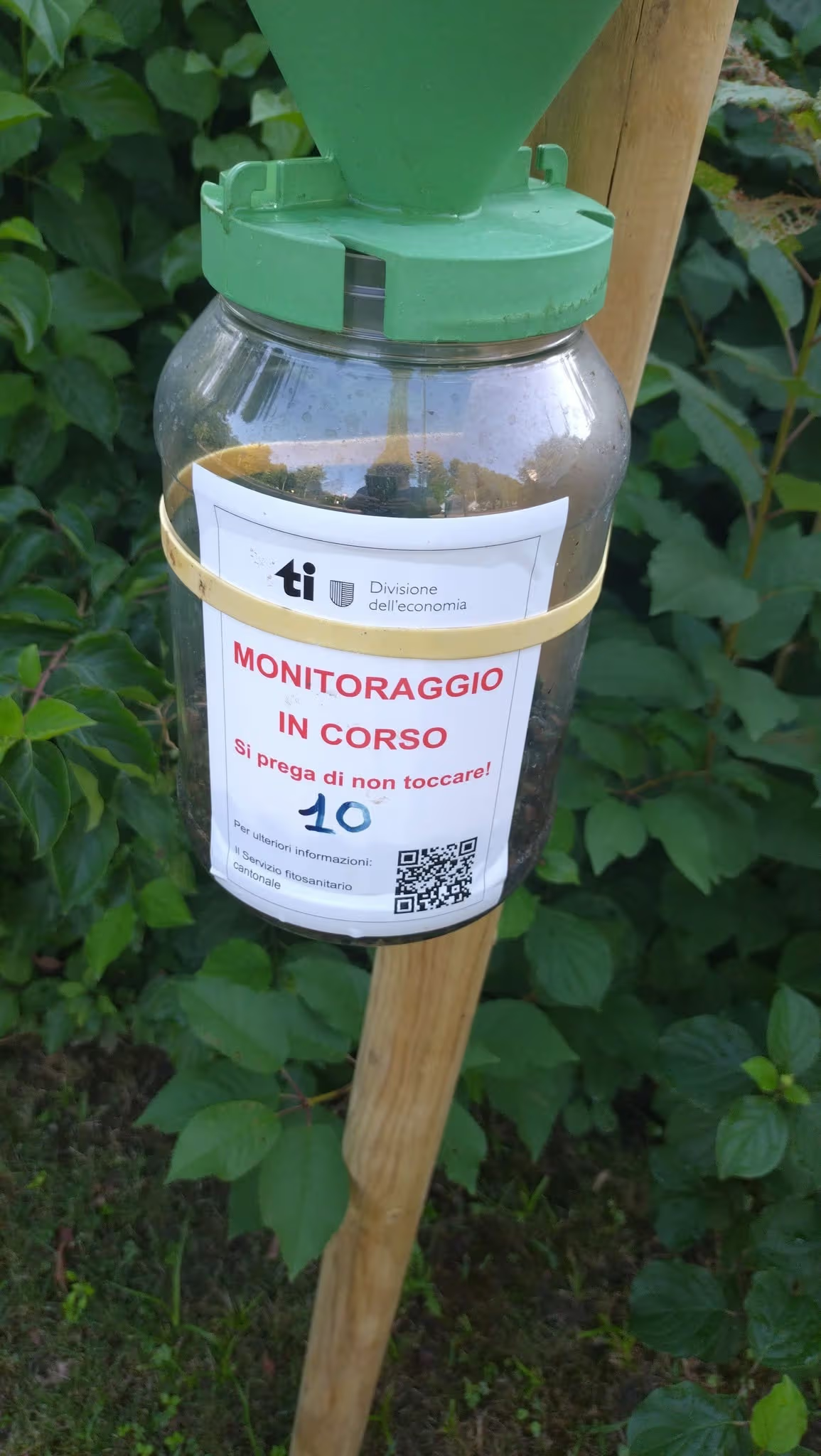
For the past few summers the Japanese beetle (Popillia japonica) has forced its way into the Ticino headlines, and rightly so: it is one of the most voracious and invasive insects to have reached Switzerland in recent years. Working every day on lawns and gardens between the Sottoceneri and the Locarnese, our clients increasingly ask us how to recognise it, whether they should worry about their lawn and what the law requires. In this guide we simply gather the official information from the cantonal phytosanitary service together with what we see in the field. That said, for the measures in force and for reporting, the official reference is always the phytosanitary service.
What is the Japanese beetle (Popillia japonica)?
The Japanese beetle is an insect native to Japan that has spread rapidly across Europe over the last few decades. In Switzerland it was first detected in 2017 in the Mendrisiotto, at the far south of Ticino, and has since gradually spread northwards; in 2020 the first outbreak was declared, and in the following years new outbreaks also appeared north of the Alps, in cantons such as Basel, Zurich and Valais.
It is a priority quarantine organism: its presence must be reported to the authorities by law, and control is regulated at federal level by the "General ruling to prevent the spread of Popillia japonica" issued by the Federal Office for Agriculture (FOAG), covering the cantons of Ticino, Valais and Graubünden. The reason for all this attention is simple: the insect is extremely voracious and feeds on more than 400 plant species, posing a serious threat to agriculture, ornamental plants and the environment.
How do you recognise the Japanese beetle?
The adult is about 8-12 mm long, a little smaller than a five-cent coin. Its head and thorax are a bright metallic green and its wing covers (elytra) are a copper-bronze colour. The detail that lets you tell it apart with certainty from similar insects, such as the common cockchafer, are the tufts of white hair: five small tufts on each side of the abdomen and two larger tufts at the rear. Adults are active and clearly visible mainly from June to September.
- About 8-12 mm long, like a five-cent coin
- Metallic green head and thorax, copper-bronze wing covers
- Five white tufts of hair on each side of the abdomen
- Two larger white tufts at the rear
- Adults active and visible from June to September
The larva, on the other hand, lives in the soil. It is a small, whitish grub curled into a "C" shape, with an orange head and three pairs of legs, and can measure from a few millimetres to about 3 cm. It develops in the soil from September to June, feeding on roots. Be careful, though: the larva looks very similar to that of the cockchafer and other beetles, and certain identification is only possible in a laboratory, with the help of a binocular microscope. If you find suspicious larvae while digging in the garden, the advice is not to destroy them all but to keep a few for identification, as we explain below.
What damage does it cause to lawns and gardens?
The damage comes from two directions. Underground, the grubs devour the roots of lawns: the grass yellows in patches, loses vigour and, in the worst cases, lifts off in strips because it is no longer anchored to the soil. These are symptoms that can easily be confused with drought or other lawn problems, but they have a very specific cause.
On the surface, the adults gnaw the leaves, flowers and fruit of a great many plants, often reducing the leaves to a fine lace (skeletonisation). Among the worst-affected plants are grapevines, roses, fruit trees (cherry, pear, peach, plum), soft fruit such as raspberry and blueberry, but also limes, maples and many ornamental garden plants. In a well-kept garden the damage can become obvious within a few days at the height of summer.
Where is it found in Ticino? The updated zones
To contain the insect, the territory is divided into zones. According to the delimitation updated by the phytosanitary service in spring 2026, Ticino is split into an infested zone (the worst affected) and a buffer zone; in practice the canton is no longer considered a "pest-free zone". The infested zone covers the Sottoceneri and much of the Sopraceneri, while the buffer zone mainly concerns the north of the canton.
This means that much of the area where we work, from the Mendrisiotto (Chiasso, Mendrisio, Novazzano) through the Luganese to the Locarnese, falls within the zones subject to measures. The exact map, municipality by municipality, is updated regularly: to find out which zone your garden is in, it is always best to check the official map on the canton's website, which you will find among the sources at the foot of this article.
To track the spread of the insect, the phytosanitary service places numerous monitoring traps across the area, like the one in the photo above: jars with a lure that attracts the adults, marked "Monitoraggio in corso" (monitoring in progress). In 2026 the number of traps installed in Switzerland rose from a few hundred to several thousand, a sign of how much surveillance has been stepped up. If you come across one in a park or along a road, it must not be touched or moved: it helps the experts estimate how widespread the pest is.
What rules must be followed in the garden and on building sites?
The zones are not just information: they carry concrete obligations designed to prevent the insect (especially the grubs in the soil) from being moved from one area to another. As a company working on the ground every day, these are rules we apply directly in our own work. In short, in the zones subject to measures:
- Excavated soil: it is forbidden to move the top 30 cm of excavated soil out of the infested zone, or from the buffer zone into the pest-free zone; from 1 October to 31 May exemptions are possible, to be requested from the phytosanitary service after a soil analysis.
- Grass clippings and plant material: from 1 June to 30 September they may not be transported out of the zone unless shredded to a maximum size of 5 cm or treated, and transport must in any case be covered with a fine-mesh tarpaulin (5 mm maximum).
- Plants with roots in soil, including pre-grown turf, may not be moved, except by companies that apply the prescribed safety measures.
- Vehicles and tools used to work the soil must be cleaned of soil and plant debris before leaving the infested zone.
- From 1 June to 30 September, landscaping companies must monitor work areas, including within a 50 m radius, and report any sightings.
Relying on professionals who know and respect these rules avoids mistakes that, besides the risk to the garden, can help spread the pest.
What should I do if I find a Japanese beetle?
If you are reasonably sure you have found an adult Japanese beetle, the phytosanitary service recommends the following:
- catch the insect without letting it escape;
- kill it, for example by putting it in the freezer, and keep it in a closed container;
- take one or more sharp photos;
- report the find to the cantonal phytosanitary service using the dedicated online form.
If you find suspicious larvae in the soil, keep a few in a closed jar: they will be needed for identification, since they are easy to confuse with other beetles by the naked eye. The point of reference for reports and information is the cantonal phytosanitary service (website ti.ch/coleottero-giapponese, phone 091 814 35 85). The cooperation of anyone with a garden or vegetable plot is essential to detect new outbreaks early.
How can we help you protect your garden?
There is no miracle "do-it-yourself" remedy against the Japanese beetle, but a regularly tended garden is far easier to keep under control. A healthy lawn makes suspicious patches of grub damage more visible; attentive maintenance helps you spot skeletonised leaves on ornamental plants early; and proper handling of grass clippings and debris, in line with the zone rules, reduces the risk of moving the insect.
Nikola Giardini e Figli SAGL carries out green-space maintenance, lawn care and gardening work throughout the canton of Ticino, from the Mendrisiotto through the Luganese to the Locarnese and the Lake Maggiore region. We can help you keep your garden under control, handle soil and clippings correctly in line with the rules in force, and step in when needed. For a site visit or a quote, get in touch.