Services
Fences and garden gates
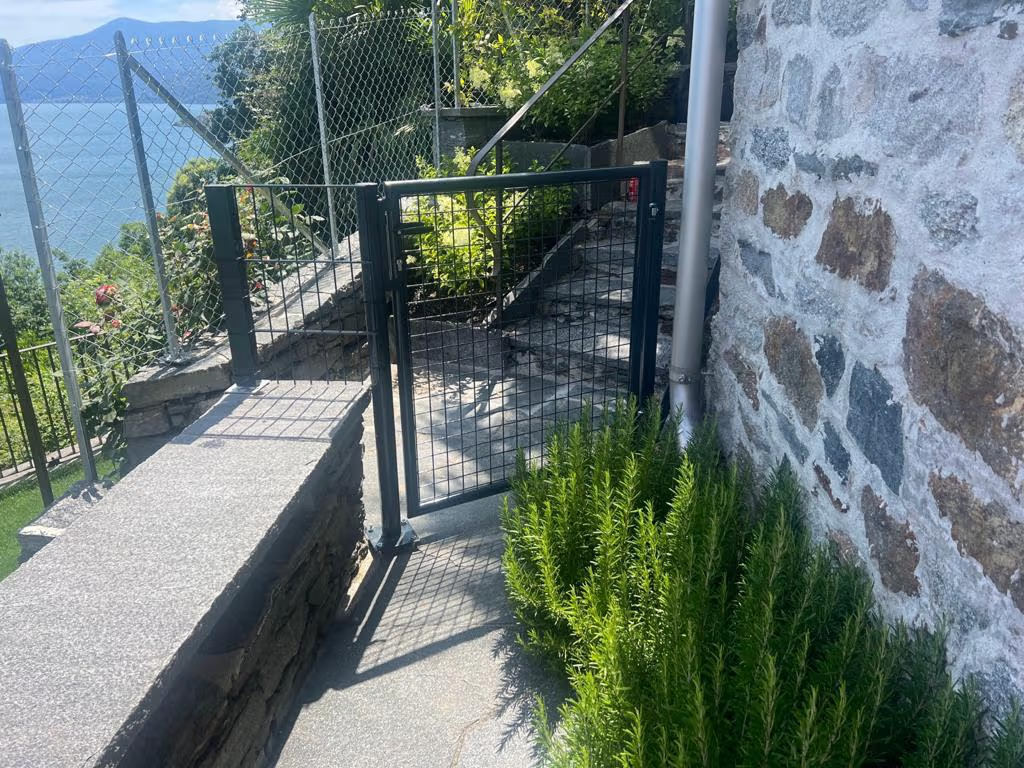
A well-planned fence defines spaces, improves privacy and completes the garden look without overwhelming it. Nikola Giardini e Figli SAGL installs fences, gates and accessories for private properties across Canton Ticino, coordinating with any ongoing planting or paving works.
In Ticino, fences need to suit very different contexts: lakeside villas between Ascona and Brissago where what matters most is the aesthetic and the integration with stone walls; hillside houses in the Locarno area where the fence has to follow terracing and changing levels; properties inland around Bellinzona or Mendrisio where more robust solutions are needed to handle level changes and vehicle access. The humid microclimate of Lake Maggiore adds particular attention to material choice: quality galvanising, paint finishes suited to lake humidity, and hardware resistant to corrosion. A fence built well today is a clean boundary that stays in good order for years.
Solutions available
- Metal fencing and pedestrian gates
- Boundaries for gardens and green areas
- Combination with stone walls or mixed fencing
- Access adjustments and passages
- Reinstatement of ground and lawn after installation
When is it worth calling a gardener for fences and gates?
The most common moment to call us is just after a purchase or a renovation, when the property boundary has to be defined or redefined. Other typical situations are gates that no longer close properly due to settled posts or worn hardware, old fencing that has rusted or been damaged by fallen branches, and changes to the garden — a new pedestrian access, a wider driveway, a separate area for dogs or children — that require the existing fence to be reworked. A site visit lets us judge whether a localised repair is enough or whether full replacement of a stretch is the more cost-effective option.
The ideal period for the work runs from spring to autumn, avoiding the wettest weeks: excavation for posts and pouring of concrete footings need stable ground and proper curing time. It pays to coordinate the fence with any other works under way — paving, walls, garden redesign — so that levels, accesses and lawn reinstatement can be planned in a single phase, without having to come back to the same areas more than once.
How does a fencing project unfold step by step?
- 1. Site visit and measurements: we survey the perimeter, check cadastral boundaries, identify pedestrian and vehicle accesses and assess level changes and obstacles (trees, services, existing walls).
- 2. Excavation and footings: we dig for the posts and gate bases and pour concrete footings sized for the load and the slope of the ground.
- 3. Posts and panels: we set the posts plumb, check alignment and levels, fix panels or mesh with correct tensioning.
- 4. Gates and hardware: we install pedestrian and driveway gates, adjust hinges and locks and check that the leaves close correctly even on slightly sloping ground.
- 5. Lawn reinstatement: we close the excavations, rebuild lawn and beds where needed and leave the site clean and operational.
What mistakes should be avoided when installing fences?
The most common mistake is undersizing the post footings. On clay-rich or sloping ground, an undersized base gives way after a few seasons and the whole fence tilts, particularly where heavy gates are mounted. The second mistake is choosing hardware and finishes not suited to the local climate: hinges and locks that are not galvanised, or low-grade paint, start to rust within the first years near the lake, where humidity is constant. Installing gates on sloping ground without allowing for the stop or for any paving offset also leads to imperfect closure and premature wear.
Other mistakes relate to the boundary itself: installing a fence without verifying the exact property line opens the door to disputes with neighbours and, in the worst cases, to having to dismantle and redo the work. Ignoring the regulatory distances from public roads or pavements can also create issues with the municipality. A careful site visit and a check against cadastral records prevent these problems before the first footing is even dug.
Professional installation
We measure accurately, set posts on stable bases and check alignment and gate closure. Where needed we carry out light excavation and restore soil and lawn around the fence so the garden looks tidy from day one.
We recommend the best solution for soil, slope and house style — from a discreet pedestrian gate to larger boundaries for the whole property.
How long does a typical fencing project take?
Timing depends on the length of the perimeter, the slope of the ground and the number of gates. A small job — replacing a pedestrian gate, installing a few metres of additional fencing — typically takes 1–2 working days. A standard residential fence of 30–50 metres with one or two gates usually needs 4–8 working days, allowing for excavation, pouring, installation and lawn reinstatement. For longer perimeters, mixed fences combined with stone walls or automated gates, we are looking at 2–3 weeks. Concrete curing times in the footings add a few days of wait before final tensioning.
Where we work
We install fences and gates in Ascona, Locarno, Minusio, Gordola, Riazzino, Brissago and throughout Ticino. Request a free quote: we assess dimensions, materials and installation time on site.